3 Best Resources To Learn Greek: Easy To Read Literature (An Interview With Margarita Ioannidou)
This is the second interview of a blog post series about three different resources of great quality, easy to use materials. The trilogy includes materials to watch, listen and read. One more interview will follow in the next little while, to conclude this series of 3 Best Resources for Greek learners. You’ll find them most helpful especially if you’re in the pre-Intermediate and Intermediate level.
Have you been looking for interesting, beautifully written stories in Greek to read at your next vacation, in class with your teacher or simply just a few pages before going to bed?
(And also…
…have you been kind of tired by the “sea, sun, souvlaki” threefold that seems to be the main topic of every easy story in Greek? Yes? Well, that makes two of us.)
This is why when I found Margarita’s work last summer, I was more than excited to get my hands on her wonderful novel adaptations that tick all the boxes: exceptional Greek authors, classic works, careful, well researched writing.
But I’ll let you discover more about her work in this email interview:
Let’s go!

How would you describe the series in a few words?
It is a series of simplified Greek literature.
My aim is to help students to enjoy, without much difficulty, some of the most beautiful books of Greek literature. And at the same time, of course, to improve their Greek.
Wonderful. How did you come up with the idea?
The idea came to me completely by chance.
A decade ago (2009-2011), I was teaching Greek to immigrants as a volunteer. I then thought “Wouldn’t it be beneficial to my students to have a book to read on their own?”. In that way, I thought, they would learn things beyond those taught in class.
So, I thought that the book Παραμύθι Χωρίς Όνομα (Tale without Name), was ideal in drawing their interest.
Here’s the story, in short: The King’s son is trying to restore his destroyed country. Eventually, he manages to inspire into people a sense of common purpose, which rises above petty personal interests. Then, all of them, united, strive for the good of their fatherland and the country eventually recovers.
I started writing bit by bit and initially I gave them just a few chapters. But they got so excited and they were asking for more! So, I completed the book and I gave it to them as a goodbye present.
A beautiful response and a beautiful present to have!
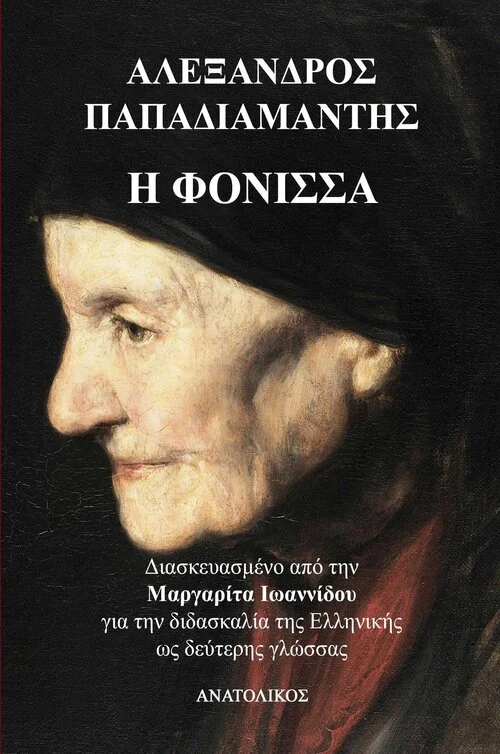
Let’s go to another book, your newest adaptation is Η Φόνισσα (The Murderess), by Alexandros Papadiamantis.
It is a powerful read, which, even though over 100 years old, remains surprisingly relevant and I applaud your choice. But why did you choose these 5 stories in particular? What's the story behind your choice?
To begin with, there are limitations set by copyright law. It is only allowed to adapt a literary work 70 years after the author’s death. Which practically means it’s forbidden to adapt the works of many great 20th century authors.
You have to resort to very old works, some dating back to the 19th century. Also, it’s very hard to find a work of that era that resonates with the modern reader.
However, these works have a common denominator: their themes are timeless. The story (or at least a variation of it) could have happened today. This is exactly why they resonate with the modern reader, despite being so old.
Yes! I agree to that.
How were you as a learner of languages? Do you identify with the readers of the novels, their challenges, their goals?
When I was learning English at school, I remember using lots of simplified English literature books. I came to love them! They helped me improve my English in such a pleasurable way. Today, fifty years later, I still have them in my library.
I have such books as well and I loved them too for the same reasons. What do you think, how can a learner use your books to learn Greek, apart from enjoying good literature?
They can be used in a variety of ways. The students, for example, can identify the verbs in the text and conjugate them, or the accusative, or the past tense, etc. Sure, we go back to grammar, but from a lot more enjoyable starting point!
You can also discuss the story in class, or the students can try to tell it in their own words, to describe the situations or the characters of the story.
So many ways to use a story for learning, for sure. Maybe a tough question, but what's your favourite story so far? Can you (secretly!) choose?
Very, very tough indeed! I cannot possibly choose one of them. Every story entices me for a different reason.
From all the characters, who would you want to have a coffee with, in real life?
It is tough to choose, but I think I’d pick the Murderess. Even though Papadiamantis describes her feelings in a masterful way, I’d have liked to talk with her, to look into the depths of her soul.
Ah... that’s an interesting - although scary - choice. I’m wondering, what was the biggest difficulty when adapting the novels?
The difficulties vary. I always aim at a short book, because the students find it hard to read a longer one.
At the same time, though, the end result has to retain the beauty and the “scent” of the original.
These two aims come into conflict sometimes; especially when the original is too long, in which case I have to make cuts. The more you cut, the more the end result might lose its appeal.
And another major difficulty is the language.
Most of these books are written in katharevousa (WN: a conservative form of Modern Greek from the 18th century) and they include idioms from the regions of Thrace or Skiathos. They include words that are not in use today.
This means that all these elements have to be “translated” into a more contemporary language that the student understands.
You've adapted 5 novels so far. How would you describe each story, using just one word?
Using just one word is hard, but I will try!
In Παραμύθι Χωρίς Όνομα (Tale without Name) it’s “hope”.
In Ποιος ήτον ο φονεύς του αδελφού μου (Who Was my Brother’s Killer) it’s the element of “destiny” in human life.
In Το μόνον της ζωής του ταξείδιον (The Only Journey of his Life) it’s “daydreaming”.
In Οι Έμποροι των Εθνών (The Merchants of Nations) it’s “tale”.
In Η Φόνισσα (The Murderess) it’s “madness”

What is the feedback about the series so far, by Greek learners?
Well, teachers who teach the books or recommend them to the students tell me about the students’ reaction. The students enjoy the fact that the lesson is appealing through the stories.
Of course, I have the experience of my own students, when I was adapting the Tale without Name. They were really enjoying the story and they were eagerly looking forward to the end!
I’m curious, how would you like to see the series evolve? Do you have any future ideas about a new title or an author?
I have various ideas. I have not decided what will follow yet. Unfortunately, there is the copyright issue that practically forbids me from adapting the works of later authors that I love.
And last but not least, where can a Greek learner find your books?
In Greece they can be ordered from any bookstore. If you want them delivered abroad, they can be ordered from the bookstores “Politeia”, “IANOS” and “Protoporia”.
Thank you so much Margarita for accepting the invitation to this email interview and for talking to us about your work with these beautiful and intriguing stories!

Margarita Ioannidou was born in Athens, in 1956. She has studied Economics at the University of Piraeus, and has worked as a Chartered Accountant.
She has taught Greek to immigrants for two years as a volunteer. As a teacher, she felt that there was a lack of appropriate texts that were simple enough for Intermediate learners, while having the capacity to capture their attention and interest. With her series of simplified Greek literature, she is trying to address this lack.
Did You Like This Article?
Get more of my best learning tips + learning offers just for Greek language enthusiasts (I might send you a bit of sunshine, too!) here: