Reading time: 8 minutes.
Let me guess. First thing that comes to your mind when you hear the word “Corfu”? ➡️ “The Durrells”! Am I right? (Unless you’re like me and you don’t really watch TV!). So, here’s something Gerald Durrell wrote in his famous book My family and other animals:
“My childhood in Corfu shaped my life. If I had the craft of Merlin, I would give every child the gift of my childhood”.
Although I didn’t spend my childhood time in Corfu like the author, I fell in love with the island when I first visited as a child during Easter. And this Easter, I wished to give my students the gift of my childhood. Did “Merlin” help? Let’s find out! ✨
Pictures by Danae Florou and Magdalena Chojnacka.
✈️ Our next Greek Easter language trip in Corfu is this April 6-10 2026! Interested in joining? ➡️ Apply here!
A journey in time
The Corfu old town is a beautiful journey in time by itself. Once you’re there, you’re surrounded by the gorgeous Venetian architecture of often up to 6 or 7-storey buildings.
It’s one of those places where you’re happy to lose your way in one of the narrow streets (καντούνια) and find yet another flower-filled balcony or the strangely cozy feeling of freshly-washed clothes hanging in plain view. And while you “escape” the charming maze of Corfu Old Town, you miraculously find yourself in front of the sparkly blue sea, which surrounds the town from north, east and south.
No wonder it’s an UNESCO World Heritage site since 2007, and the pride of Greece during Easter.

This is exactly where we spent the Holy Week (Μεγάλη Εβδομάδα) with a group of lovely students from Belarus, Denmark, England and USA. And this is the story of our language & culture trip during Easter.
Sit back, read along, and let your mind wander, as if you were with us in Corfu!
Day 1: Walking in Saroco before the rain
Meeting my students for the first time or again in person after some time, is something that always makes me so happy. I’m always grateful about the potential of technology, but meeting in person has a different feeling. It makes the teaching & learning much more complete, I think.

After our first classes on Day 1, we went for a quick coffee close to the Saroco square (latin name: San Rocco), where our classroom is located.
Because we had talked a lot in class about the Easter traditions in Greece, students also played a language game related to our topic, while walking around the neighbourhood.

There’s nothing better than experiential learning, and it was a lot of fun discovering some beautiful buildings, useful places, and words we had already seen in class.
Since it was Holy Monday (Μεγάλη Δευτέρα), we were still fortunate to enjoy the town without the crowds. The light rain at the end of our walk reminded us how we’re in the Ionian islands after all (Τα Επτάνησα - τα νησιά του Ιονίου), where there’s always some rain during spring!

Day 2: Kumquat & blue skies
On Day 2, students learned about local dishes and traditional Easter recipes, while practicing tenses & nouns.
Corfu is famous for dishes such as σοφρίτο (veal cooked in wine & garlic) or παστιτσάδα (pasta with meat sauce & spices), among several other dishes and delicacies unique to the island, such as kumquat (το κουμκουάτ).
One of my students, A., who lives on the island, brought kumquats from her garden and some sweets with the fruit. The aroma was incredible.

Right after our classes, we headed to the Old Fort (Παλιό Φρούριο). The day was windy and cloudy, but as soon as we arrived to the Fort we got blessed with incredible skies, and an amazing clear Spring sunlight.
Climbing the Fort is difficult not because of the route, but because of the views; you simply can’t resist taking pictures every 5 steps! We chatted a lot on our way up and I think everyone shared the same sentiment of awe.
Day 3: Ancient tales
Day 3 continued with the Archaeological Museum exploration. We talked in class about the Museum and its artifacts (especially Medusa and the Lion of Menekrates - η Μέδουσα και το Λιοντάρι του Μενεκράτη) , and continued our grammar & vocabulary practice through learning about one of Corfu’s most significant museums.

Our visit to the Museum later in the afternoon brought everything together: We stood amazed in front of the Medusa, whose figure was almost 3m. tall (almost 10 ft).
As we found out during our visit, and probably as someone can guess from experience, figures on Greek temples (or on the pediment - το αέτωμα) usually appear more realistic, in both appearance and size.
But Medusa stands out as a gigantic figure with a terrifying, monster-like gaze.
I can only imagine what it was like standing in front of her once colourful figure on the Temple of Artemis, back in the 6th century BC!
By the way, I found this great article about Medusa. Read it if you want to learn more about her story.
Day 4: We have a guest!
On Day 4, our lessons continued with the unique Easter traditions of Corfu, where students read texts about the Easter custom of botides (μπότηδες), the big and small red clay pots filled with water, thrown on Holy Saturday morning from the balconies.
We also discussed the customs of the next few days in our speaking activities: η Ανάσταση (Resurrection), τα πυροτεχνήματα/βεγγαλικά (fireworks), το Πασχαλινό γεύμα (Easter meal).

After our classes, Magdalena, our guest and history & culture enthusiast, came to the school and shared with us the history of Corfu from ancient times until today, as well as many Corfiot words & expressions (unique to this part of Greece), and lots of fascinating details about the Easter customs of the island.
It was an incredible presentation/discussion with Magdalena and I’m grateful for her taking the time to talk about topics she’s passionate about! Ευχαριστούμε πολύ!😊
Day 5: An old wooden soap factory & music in the streets

Our days have been busy for sure! And Good Friday (Μεγάλη Παρασκευή) is an extra busy day for Corfu.
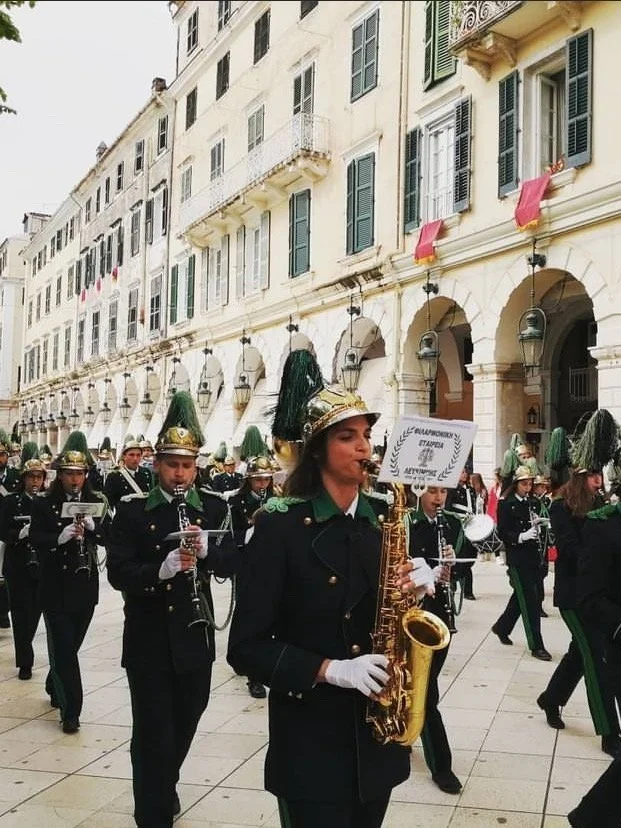
The relaxed island town pace of the previous days was soon replaced by bustling streets and the closure of the town centre to all cars, so that people (and soon, the Philharmonic bands of Corfu!) would walk freely & safely around, during the Easter festivities.
Our in-class learning had come to an end, but our outside learning adventure was continuing.
On Day 5, we got to visit a gorgeous little wooden soap factory (σαπωνοποιία), where the owner kindly explained the long history of the place and the process of handcrafted olive oil soaps in the traditional way.
Later, we prepared (also, mentally!) to navigate the crowded Old Town and watch the Epitaph (Επιτάφιος), the Holy Friday Procession.
In Corfu, this is done quite differently than then rest of Greece: the Philharmonic bands follow the various Processions while playing mourning songs.
In the narrow streets of Corfu, this means hundreds of people following each Church’s Epitaph, and each Church has a different schedule, to avoid overlapping. It was spectacular to hear & watch the bands showing up one after the other.
Days 6 & 7: Celebrating Easter and keeping memories!

For Holy Saturday’s big event, we got early to the Spianada square (Σπιανάδα) to get a relatively good spot and watch - what else? - the botides (μπότηδες) custom for the “first Resurrection of Christ” (Πρώτη Ανάσταση).
The sun was shining throughout our week on the island (quite a miracle for Spring in Corfu), so the shade under the trees was welcome!
Right before 11 am, the anticipation was peaking, and people started counting backwards: 3, 2, 1… and the party began: numerous clay pots big, small or huge (notice the one falling while spraying water at the bottom right of the picture!) started falling from the balconies, which were decorated with the distinct red cloth.
That moment also brought back memories, as it was at this exact square I first saw the botides tradition as a child. With perhaps twice the amount of people, and cameras being replaced by hundreds (thousands?) of phones, it was otherwise the same as I remembered it: exciting, chaotic, fun, cathartic.

And at the same time, the reason why I love our tiny country; the variety of traditions from one place to the other is mind-blowing, and being able to share this with my students in our language & culture trips in Greece is an incredible privilege and joy!
Back to our day on Holy Saturday, we decided to defeat any fatigue, and walk to Mon Repos park. The peace of the place was very welcome and the gorgeous blue of the sea promised that summer is getting close.
Later at night, I met with my student, B., and attended the Resurrection outdoors at the Spianada square, where we watched the 10-minute (!) fantastic firework show by the sea. The picture below doesn’t do it justice, so you can watch this video instead. Χριστός Ανέστη!

For our final day on the island, we met with my students for the Easter meal; traditional lamb, with several salad options, as per the custom! It was delicious and the best way to conclude our Easter week in Corfu.
By the way, to read more about the typical Easter traditions (the ones that are common all over Greece) read here another article about Easter, with several phrases you can use during the Greek Orthodox Easter celebration.
I miss everyone from our lovely group! But I’m happy we at least met with some of them in our Athens language & culture trip - blog article to follow soon!
✈️ Our next Greek Easter language trip in Corfu is this April 6-10 2026! Interested in joining? ➡️ Apply here!