
What’s the difference between learning to speak fluently / at an advanced level and sounding like a local?
Obviously, studying and being focused helps you progress.
But when it comes to speaking, like “real life speaking” with locals, studying might not be the only thing you can do.
When I first came to Canada, my English was at an advanced level.
I could attend University lectures and talk about these topics adequately. I could write an essay.
When it came to speaking about everyday topics though? Not even close.
Avoid sounding like a robot
Think of it this way: Do you use the same vocabulary, tone and structure at your local shop and at a university class? How do locals speak to each other in informal context? What makes natural speaking, natural?
Back to my story, I took a conversation class to boost my speaking about everyday topics and also learn about local small talk.
Also, I started paying attention to the way locals spoke to each other; noted everything down and attempted to use it, to sound more natural.
And here’s what I ‘ve found: There is a way to learn how to sound more natural and gain a better speaking flow, even before reaching the advanced level.
It's a little trick that has to do with using pauses and little words to your advantage.
Pauses that include filler words.
Here’s a visual example to see what I mean:
What makes a Christmas tree a great Christmas tree? Imagine a tree like this one:
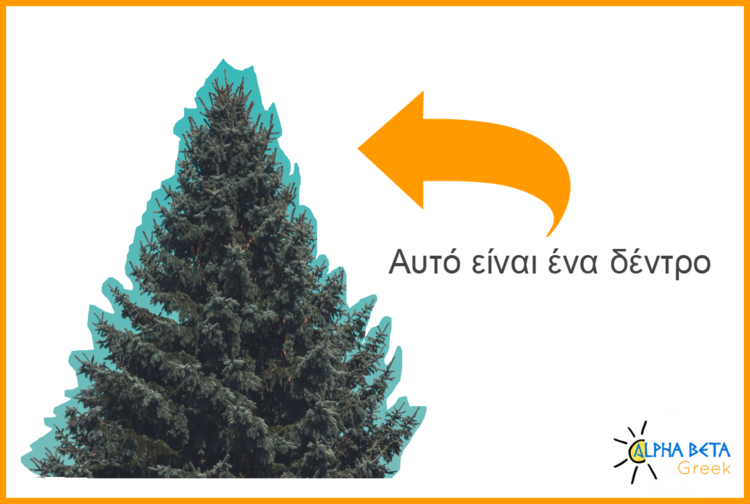
And then imagine adding fillers. Such as ornaments, extra branches or garlands.
Fillers fill in the space between the branches and make your tree stand out; as with ornaments, filler words you naturally use in your native language can help your sentences sound richer.
This is also true when you speak Greek.

Why are filler words useful for your speaking?
Filler words are a natural pause to think, without stopping speaking altogether
They also help your audience understand you have more things to add
Lastly, filler words add colour and liveliness to your speaking
What does λοιπόν, βασικά, έτσι mean in Greek?
Below, you’ll find a list with 7 very common filler words & sounds you can use in Greek.
At the end of the list, you’ll also find short & practical ideas to use in your speaking and also a link to a YouTube video by the Easy Greek team, to watch and listen how to use more filler words.
Πάμε!
1. Λοιπόν
Translated as “so” or “well”, λοιπόν initiates a topic if used at the beginning of a sentence, or at the end of a question:
Λοιπόν, πάμε να μιλήσουμε για τα ρήματα τώρα.
Τι θα φάμε, λοιπόν;
It even connects sentences, when one of them is the conclusion:
Αγαπώ την Ελλάδα, γι’ αυτό λοιπόν έμαθα ελληνικά!
2. Έτσι
“Like this”, έτσι: when used as a filler word it goes after a question in order to reinforce the meaning, especially when you know the others agree or have to agree with you:
Δεν είναι σωστό, έτσι;
It’s also used when you explain something to others:
Μου αρέσει, έτσι, να πηγαίνω βόλτα στην Αθήνα.
3. Βασικά
If you know how young people use “basically” in English, then βασικά is basically the same thing. It highlights the meaning of a sentence, at the beginning of a sentence, in the middle or even at the end:
Βασικά, δεν ξέρω την αδερφή της.
Δεν ξέρω, βασικά, την αδερφή της.
Δεν ξέρω την αδερφή της, βασικά.
4. Εεεεεε …
Not a word, but a sound, as the sound “um” in English. Use it when you try to think or remember something at the beginning of a sentence. It can prove very handy as you try to remember a certain word; Greeks tend to use it a lot!
Εεεεεε … νομίζω ότι μου αρέσει πολύ αυτό το βιβλίο.

5. Θα έλεγα
This means “I’d say” and as a filler word goes well with statements, such as:
Είναι, θα έλεγα, τα πιο ωραία σουβλάκια της Αθήνας!
6. Ας πούμε
This means “let’s say” and it’s used for examples, when explaining something to others or telling a story:
Το ωραίο κλίμα, ας πούμε, είναι από τα θετικά της Ελλάδας.
Και τότε όλοι έμειναν, ας πούμε, σπίτι και έπαιξαν χαρτιά.
7. Ξέρω ’γω
This is commonly used when you’re wondering about something, since it's literally translated as "do I know (?)" but really means "I don't know":
- Σου αρέσει αυτό το τραγούδι;
- Ξέρω ‘γω; Καλό είναι.
Among young people, it can be used much more frequently, between any word or meaning - it can be a bit too much:
Θα πάω, ξέρω ‘γω, αύριο να δω μια ταινία…. άκουσα, ξέρω ‘γω, ότι η ταινία αυτή ήταν, ξέρω ‘γω, καλή.
As with your native language, find the right amount of how and when to use them to get this nice flow when you speak - even if at the same time you're looking for the right word to say.
Lists are wonderful but not without actually practicing what you learn. Here are some ideas to practice more speaking and improve your flow in Greek:
Check out my $9 speaking membership program, Chats/Κουβέντες!
Also, here is the YouTube episode by the Easy Greek team where you can actually listen to many more filler words. Enjoy!
Did you like this article?
Get more of my best learning tips & learning offers just for Greek language enthusiasts (I might send you a bit of sunshine, too!) here:

![How to manage perfectionism when you speak Greek? [article + video]](https://images.squarespace-cdn.com/content/v1/5fca9d1fc430437d9a90fc38/1609284434605-ONKAQUXGEY7Q8YIO9DBW/perfectionism.png)