
Test how much you know!
Christmas in Greece can surprise you. The Greek Christmas table might overwhelm you. And Greeks will wholeheartedly welcome you to their Christmas feast.
In this guide you’ll find the most significant, traditional and fun things to say, write, do, celebrate and share with your Greek friends and family.
From writing or saying your wishes in Greek to cutting Βασιλόπιτα (New Year’s pie /bread);
From singing the Greek κάλαντα (carols) to knowing when to leave cookies and milk for Santa... or should I say Άγιο Βασίλη? (hint: it’s not on the 25th);
This is your guide if you ‘re spending Christmas in Greece or if you’re simply curious to find out more about this special Greek holiday.

#1 The Christmas holidays
“Τι θα κάνετε τα Χριστούγεννα;”: What are your plans for Christmas?
When a Greek asks about Christmas, they don't necessarily mean the Christmas day.
Rather, it's the holiday season starting from the Christmas Eve (December 24th) to the Epiphany Eve (January 5th).
This is called the 12 days of Christmas and includes three major celebrations: Christmas (τα Χριστούγεννα), the New Year (η Πρωτοχρονιά) and the Epiphany (τα Θεοφάνεια/τα Φώτα).
It’s the season to meet friends and family and eat lots of delicious Greek food.
Music, theatre, indoor and outdoor events are frequent; Greeks love spending time outside.

A fun & joyful bilingual Christmas course for Greek students with traditions, wishes, stories, activities, carols, recipes, quizzes and much more! Not your average "culture" course: In this course, we dive deep, explaining several century old traditions, learning what wishes exactly to say or write for every occasion, and exploring this beautiful season in Greece with a fun & festive spirit!
Bonus info: Name days.
If you have a Greek in your life named Christina or Fotini (female), Vasilis or Christos (male):
On Christmas day it’s the name day of all Greeks named Χρήστος (Christos) and Χριστίνα (Christina).
The New Year’s day is the celebration of Άγιος Βασίλειος or commonly, Άι Βασίλης (Saint Basil/Vasileios). It’s the name day of everyone called Βασίλης (Vasilis) and Βασιλική (Vasiliki).
Άγιος Βασίλης is also the Saint who brings the presents to children; so January 1st is a day much anticipated.
Lastly, the Epiphany is the name day of Greeks named Φώτης (Fotis for men) and Φωτεινή (Fotini for women).
Go ahead and wish “Χρόνια Πολλά” to the Greeks in your life who happen to have these names!
#2 Wishes
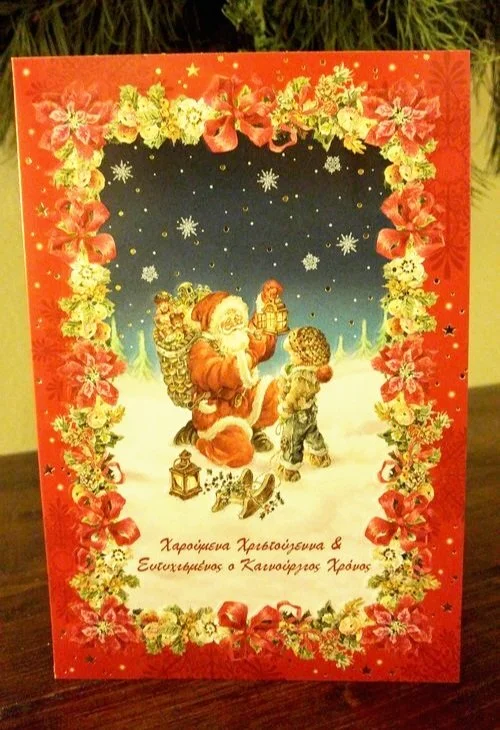
You won't really hear “Merry Christmas” on Christmas day.
You see, Merry Christmas in Greek is “Καλά Χριστούγεννα” but Greeks say this to each other the days up to the Christmas day.
On Christmas day, Greeks say “Χρόνια Πολλά” which literally means “Years many” (“Years many to live and prosper”: this wish is also used on birthdays, on name days and religious celebrations.)
Why don’t Greeks wish “Καλά Χριστούγεννα” on Christmas day?
Because when you wish using the adjective “good”: καλός, καλή, καλό, it is usually for things or events that haven’t happened yet. Once they happen, they belong to the past.
An example is “καλό μάθημα” (“have a happy/good class!”) Once your class has already started, there is no need to wish this anymore.
In the same way, Καλά Χριστούγεννα actually means “Have a good Christmas day”. Once the day is here (and Christ is born), “Χρόνια Πολλά” takes its place as a wish.
Bonus info: Wish to your Greek friend over the phone
How about calling your Greek friends and family on the phone to wish them in Greek?
In some cultures, texts or emails have replaced phone calls. Of course you can send messages to your Greek friend, too. However, a phone call is still very much appreciated by Greeks - on name days and celebrations, the phone is ringing non stop.
# 3 Greek Christmas food
Isn't this everyone’s favourite part?
From savoury to sweet, traditional & local to non-traditional, Greek Christmas food is something that brings beautiful, warm memories. It’s not just about the food, but about the gatherings and the sharing.
But what’s so special about the Greek Christmas food, compared to other days or celebrations?
On Christmas day pork, turkey, greens, salads, roast potatoes and the large variety of Greek pies is what Greeks have traditionally.
The special bread we make and set on the table is named “Χριστόψωμο”: Christ’s bread. This is a bread made with honey, spices and nuts, decorated with shapes made out of dough.
The family gets together on December 25th and the Christmas lunch starts the same time as lunch does in Greece; around 2 pm or even later.
On the New Year’s eve everyone - and I mean everyone, adults and kids alike - stays up until at least midnight.
This is the moment to cut the “βασιλόπιτα”: Saint Vasileios’ pie. In this special pie (which can be a cheese pie or even a vanilla cake) we hide a coin.
Whoever finds it in their piece is lucky for the whole year!
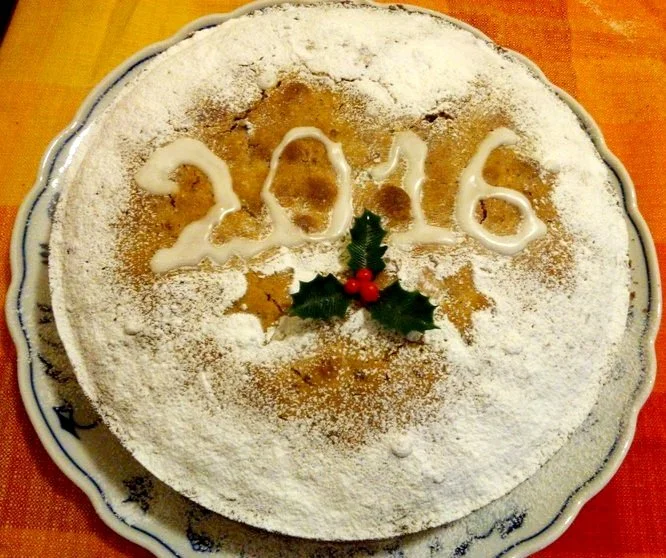
This is a "pie" I made back for 2016 New Year’s, which is simply a vanilla cake with nuts and dry fruit. Far from professional, but homemade and yummy.
Bonus info: Cut the pie
Surprise the Greek in your life and cut the βασιλόπιτα like a pro; Don’t laugh, I know you can do it.
Here’s how: First, make the symbol of the cross 3 times over the pie with the knife.
Over is important. Don't spoil the fun by cutting through and revealing the coin!
Then, start cutting the first piece and say “για τον Χριστό”: “for Jesus Christ”, continue with the next one “για την Παναγία”: “for Mother Mary” , the next one “για τον Άη Βασίλη”: “for Saint Vasileios”, then “για το σπίτι”: “for the house” (which means the house you’re at the moment) and then - and only then! - start saying the names of the family and friends who are with you starting from the oldest to the youngest.
Members of the family who are not present, they always have a piece dedicated to them as well.
(Did you start wondering if you'll actually get a piece yourself? You will, you will. Just cut the first pieces smaller. Shhh. I didn't say that.)
Time for ...more dessert!
The most popular Greek Christmas treats are “κουραμπιέδες”: sugar cookies/short bread, “μελομακάρονα”: honey biscuits and “δίπλες”: this one is fried dough in a folded shape thus the name, which means exactly that; “folded”.
Based on honey, nuts, olive oil or butter and spices, these treats are made of the very best ingredients Greece has to offer.
In Greece, you can find them during the Christmas time only. Greeks make tons of them to offer to family and friends and bakeries sell them in abundance. As you can imagine, everyone ends up with large quantities of treats.
Bonus info
(I guess the only “bonus” here is the pounds we gain?)
# 4 Carols
While celebrations are more or less the same, every region (and in many cases even different places in the region) can have different customs such as different carols or special dishes.
Greece is a tiny country with a lot of variety.
“Κάλαντα”: the Christmas carols are traditionally sung by groups of children visiting house after house and shop after shop on Christmas Eve, always in the morning.
Since Άγιος Βασίλης (Saint Basil) is celebrated on New Year’s day, these carols are dedicated to him.
Gradually however, the "man in the red suit" has taken the place of Saint Vasileios in kids’ stories and decorations.
Rudolph, the North Pole and the elves have also been added to the stories about the Saint, who seems to be coming from two different places and traditions, on two different dates: on New Year’s day for the typical Greek tradition and on Christmas day.
Bonus info: Money for carols?
Children in Greece can’t wait to sing the Christmas carols.
They don’t get treats, they get money (just a few coins but for a child this is of course a fortune) so they are eager to wake up early and sing until the afternoon.
Did I sing κάλαντα as a kid? Of course I did. With a musical triangle of course - it is a must!
# 5 How to celebrate
If you’re spending the holidays in Greece this year, here are a couple of things that might help you get oriented easier:
Decorate a tree a few days before Christmas and keep it until the Epiphany. Before the tree decoration which started around the 19th century in Athens, Greeks didn't decorate; a miniature boat was often displayed at homes or a simple candle was lit.
The boat decoration has been revived the last years and many town squares have large light decorations in the shape of a boat.
Stories about the mischievous spirits who manage to surface from underground, the "καλλικάντζαροι": (kallikantzari) goblins, are told by the fireplace; this time of the year I remember my grandfather, who was an excellent storyteller. His stories would send a chill down our spines for days!
Breaking a pomegranate open on New Year's day in front of the main door is a tradition in some areas to this day; pomegranate is considered to bring luck and prosperity.
And lastly, on Epiphany day, the blessing of the water takes place; the priest throws the Cross in the sea, lake or river and swimmers dive to catch it.
Aside tradition, so many events happen in cities and towns, day and night. And they all take place in public squares and open spaces.
Be prepared to spend lots of time outside and why not, enjoy the Greeks’ favourite pastime; going out for a coffee. Not the quick, one shot kind. Slow your pace and enjoy a good conversation or your book or, simply, the view.
With all my heart, I wish you:
Καλά Χριστούγεννα και Καλή Πρωτοχρονιά!
What’s your favourite Greek Christmas tradition? Share in the comments!
CURIOUS TO LEARN MORE? ✨ACCESS HERE THE GREEK CHRISTMAS COURSE!✨
A fun & joyful bilingual Christmas course for Greek students with traditions, wishes, stories, activities, carols, recipes, quizzes and much more! Not your average "culture" course: In this course, we dive deep, explaining several century old traditions, learning what wishes exactly to say or write for every occasion, and exploring this beautiful season in Greece with a fun & festive spirit!
Have fun and learn with 5 Units on Greek Christmas, plus the downloadable 20-page workbook!
This online course and the 20-page PDF workbook are for all Greek students who want to explore Christmas in Greece. Learn with:
Audio, video & text in Greek & English
Fun activities, crosswords & quizzes
Festive glossary & flashcards
Ceturies-old traditions
Delightful carols
Delicious recipes