
Reading Time: 6 minutes
Do you ever get confused with the use of Future tenses in Greek?
For example, why & when to say:
“Θα πιω νερό” instead of “Θα πίνω νερό”?
“Η Άννα θα φύγει αύριο” instead of “Η Άννα θα φεύγει αύριο”?
“Θα διαβάσουμε πολλά βιβλία” instead of “Θα διαβάζουμε πολλά βιβλία”?
Today I’m going to show you how to distinguish these two future tenses, so that you can use them with more confidence by the end of this guide.
Get your coffee or tea and let’s dive in!

First of all, there are 3 future tenses: Simple, Continuous and Future Perfect.
Here, we’re looking at the two first, the Simple and the Continuous, which are also the most common ones.
#1 The Simple Future
In my favourite Grammar for Greek learners, Greek: An Essential Grammar of the Modern Language, this tense is also called Perfective Future and it’s the most common in everyday speaking.
It’s formed by θα + the perfective stem - which is also called the “aorist theme/stem”.
What does this practically mean?
The perfective stem is none other than a small but important part of the verb when the verb is in Simple Past.
For example, the verb φεύγω has the perfective stem of - φυγ -. You know this when you learn the Simple Past: φεύγω → έφυγα → θα φύγω.
The small part in the middle (think of it as the “body” of the verb): this is the perfective stem -φυγ- .
This is practically the reason why in most cases you learn the Simple Past first (Αόριστος: Aorist) and then the Simple Future. By knowing the perfective stem -φυγ- you can then go ahead and “construct” the Simple Future.
How? By using θα + the perfective stem + the present tense ending:
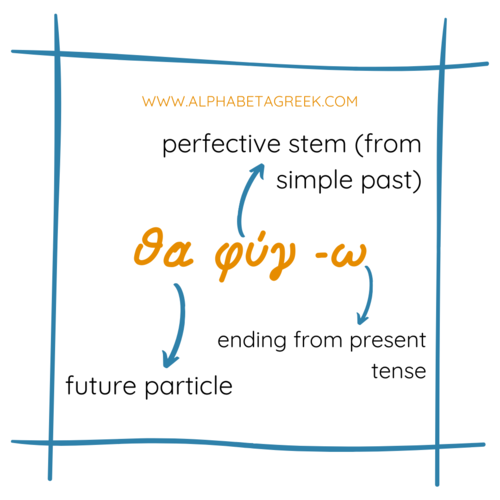
θα φύγ-ω
θα φύγ-εις
θα φύγ-ει
θα φύγ-ουμε
θα φύγ-ετε
θα φύγ-ουν
NOTE: There are a few cases where this rule doesn’t apply. What’s grammar without exceptions, right? One of these verbs is πάω → πήγα → θα πάω.
That’s it about how to form the Simple Future. Let’s move on to how to use it.
When to use Simple Future
The “job” of this tense is to describe future actions potentially completed at a specific time, without indicating the actual duration of the action.
Let’s see how:
α. πίνω: to drink→ θα πιω, because the perfective stem is -πι- from the Simple Past ήπια.
Imagine you’re reading the menu at a café. Your friend asks you:
"Τι θα πιεις; : What are you going to drink?"
Even if there is no clear indication of time (such as “tomorrow”, “at 10 am” etc), the question is about what will happen in the next moment, in the immediate future. You go ahead and reply:
"Θα πιω έναν καφέ. I’ll drink a coffee."

Let’s see another example:
β. τακτοποιώ: to tidy up → θα τακτοποιήσω, because the perfective stem is τακτοποίησ- from the Simple Past τακτοποίησα.
You ask your partner:
"Θα τακτοποιήσουμε σήμερα το σπίτι μετά τη δουλειά; Are we going to tidy up the house today after work?"
Here, the question is about a future action to be potentially completed at a specific time: “today after work”.
Now let’s see a last example:
γ. μαγειρεύω: to cook → θα μαγειρέψω, because the perfective stem is μαγειρεψ- from the Simple Past μαγείρεψα.
"Τι θα μαγειρέψουμε για τους φίλους μας; What are we going to cook for our friends?"
In this case, there is a general future reference. The action will be potentially completed in the future in general.
To recap:
All the examples above use Simple Future to talk about future actions, without getting into details about how long these last.
They might or might not include an indication of time, such as "αύριο: tomorrow", "το μεσημέρι: at noon", "τον επόμενο μήνα: next month", "τη Δευτέρα: on Monday" etc.
The indication of time can be as vague (no indication at all) or as specific as: at 10:30 am. Tomorrow night at 11. On Monday morning.
All the actions will be (potentially) completed in the future.
Now, back to you: How did it go so far? Remember to ask me any questions in the comments below!
Next you’ll see:
#2 The Future Continuous
This is also called the Imperfective Future.
Things are a lot simpler with forming this tense. This Future is formed only with the future particle θα + the verb in present tense. That’s it!
When to use Future Continuous
The “job” of this tense is to describe future actions that might be repetitive, for example describing a habit, a routine or continuous actions.
This tense also focuses on the duration. This is why you’ll see some “key phrases” below, such as “all afternoon”, “every day”.
Let’s see some examples:
α. κοιμάμαι: to sleep → θα κοιμάμαι
"Το καλοκαίρι θα κοιμάμαι πολύ αργά. In the summer, I will be sleeping very late."
The action here is repeated: you’ll be sleeping late every night or most nights. This is why you use the Future Continuous.
β. βγαίνω: to go out - θα βγαίνω
"Θα βγαίνω κάθε μέρα για περπάτημα. I’ll be going out for a walk every day."
Again, here you’re talking about going out for a walk every day. By using the phrase “every day”, you indicate the repetition.
γ. γράφω: to write - θα γράφω
"Η Μυρτώ θα γράφει όλο το απόγευμα. Myrto will be writing all afternoon."
In this case you talk about Myrto who’s writing all afternoon. Since it’s something she’ll be doing the whole time, Future Continuous is the appropriate tense to use.
To recap:
You use Future Continuous when you want to talk about habits, routine and continuous acts in the future.
To indicate the time and duration, you can use phrases such as "όλη μέρα: all day", "όλο το απόγευμα: all afternoon", "κάθε μέρα: every day" etc. You can even use more specific time, such as “at 9 am” or “on Tuesday night”.
The point here is that you focus on the duration of the action, not just on its completion in the future (as it is the case with Simple Future).
How does it sound so far? Are you now ready to make your own sentences - how about your New Year’s resolutions?
You might need both future tenses, depending on what you want to do.
Is it something you’re aiming to complete this year? Then → Simple Future.
Is it something you promise doing every day, like a habit? Then → Future Continuous.
Some ideas to get you started:
Simple Future:
Θα μάθω ελληνικά. I’ll learn Greek.
Θα πάω ταξίδι στην Ισλανδία. I’ll go for a trip to Iceland.
Θα γραφτώ στη χορωδία. I’ll sign myself up for the choir.
Θα καθαρίσω την αποθήκη (επιτέλους!). I’ll clean the storage room (at last!).
Θα ξεπεράσω τους φόβους μου. I’ll overcome my fears.
Future Continuous:
Θα περνάω περισσότερο χρόνο με την οικογένειά μου. I’ll be spending more time with my family.
Θα κοιμάμαι νωρίς. I’ll be sleeping early.
Θα πηγαίνω κάθε Σάββατο στο γυμναστήριο. I’ll be going every Saturday to the gym.
Θα φροντίζω τον κήπο μου. I’ll be taking care of my garden.
Θα διαβάζω περισσότερο. I’ll be reading more.
What are your resolutions this year? Let me know in the comments!
Thank you for learning with me,
~ Danae
What’s next?
Practice your tenses in context! Check out the Free Ιστολόγιο | Greek blog for students, with articles created exclusively for the intermediate learner.
Did you like this article?
Get more of my best learning tips & learning offers just for Greek language enthusiasts (I might send you a bit of sunshine, too!) here: